


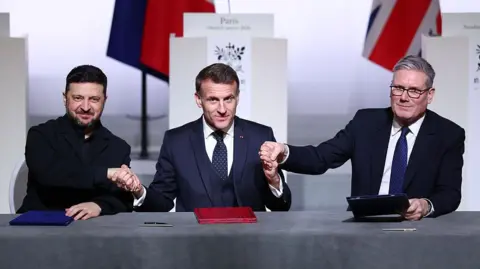
The UK and France have formalized a statement of purpose concerning the stationing of armed personnel in the nation in the event a ceasefire be made with Moscow, the UK Prime Minister, Sir Keir Starmer, has declared.
Subsequent to talks with Kyiv's partners in Paris, he said that the UK and France would "create operational bases in various parts of Ukraine and construct fortified facilities for military hardware and military equipment" to prevent any future attack.
The partner countries also suggested that the United States would take the lead in verifying a truce.
Russia has repeatedly cautioned that any foreign troops in Ukraine would be considered a "valid objective", but has so far not issued a statement on this latest announcement.
Background and Continuing Conflict
The Kremlin's head Vladimir Putin began a full-scale invasion of Ukraine in the start of last year, and Russia presently occupies approximately 20% of Ukraine's sovereign soil.
"This constitutes a crucial element of our vow to be alongside Ukraine for the long-term," stated Starmer.
Top officials and top officials from the "Partner Group" participated in the Paris negotiations.
Speaking at a combined announcement, he further said: "It paves the way for the operational parameters under which allied and coalition forces could function on Ukrainian soil, defending Ukraine's air and maritime domains, and restoring Ukraine's defense capabilities for the years ahead."
The British leader added that London would be involved in any American-headed monitoring of a prospective truce.
Defense Assurances and Negotiation Stances
Senior Washington representative Steve Witkoff said that "lasting defense assurances and strong economic promises are critical to a lasting peace" in Ukraine – mentioning a major requirement made by the Ukrainian government.
Witkoff noted the coalition had "mostly completed" their work on establishing such guarantees "to ensure the citizens of Ukraine know that when this conflict ends, it ends permanently."
The former US envoy, former American President Donald Trump's representative, also was involved in the negotiations.
Meanwhile, France's leader Emmanuel Macron said that Ukraine's allies had made "considerable headway" at the meeting.
He said that "robust" safety pledges for Ukraine had been reached in the event of a potential ceasefire.
President Volodymyr Zelensky said that a "major advance" had been made in Paris, but added that he would only view efforts to be "sufficient" if they led to the conclusion of the war.
Recently, he said a peace agreement was "mostly finalized". Agreeing on the outstanding 10% would "determine the fate of the peace, the future of Ukraine and Europe".
Unresolved Issues
- Territory and defense assurances have been at the heart of unresolved issues for diplomats.
- The Russian President has repeatedly warned that Ukrainian troops must retreat from the entirety of Ukraine's eastern Donbas or Russia will seize it, refusing any concession over how to end the war.
- The Ukrainian President has so far ruled out surrendering any land, but has suggested that Ukraine could pull back its troops to an agreed point – but only if Russia follows suit.
Moscow currently occupies about 75% of the Donetsk oblast and around 99% of the bordering Luhansk region. The two regions form the area of the Donbas.
The original US-led comprehensive peace plan that was circulated to the media last year was viewed by Kyiv and its European allies as being heavily skewed in Russia's direction.
This led to weeks of intensive discussions – with Ukraine, the US and European leaders trying to amend the draft.
Recently, The Ukrainian government sent the US an revised 20-point plan – as well as additional documents outlining prospective security guarantees and plans for Ukraine's rebuilding, he stated.
